
Hip mobility often feels unpredictable.
Some days range is there, other days it disappears. Stretching seems to help, but the body doesn’t feel supported inside the movement.
This course approaches hip opening as a skill that can be learned.
One that combines range, strength, and control, so flexibility becomes something the body can rely on.
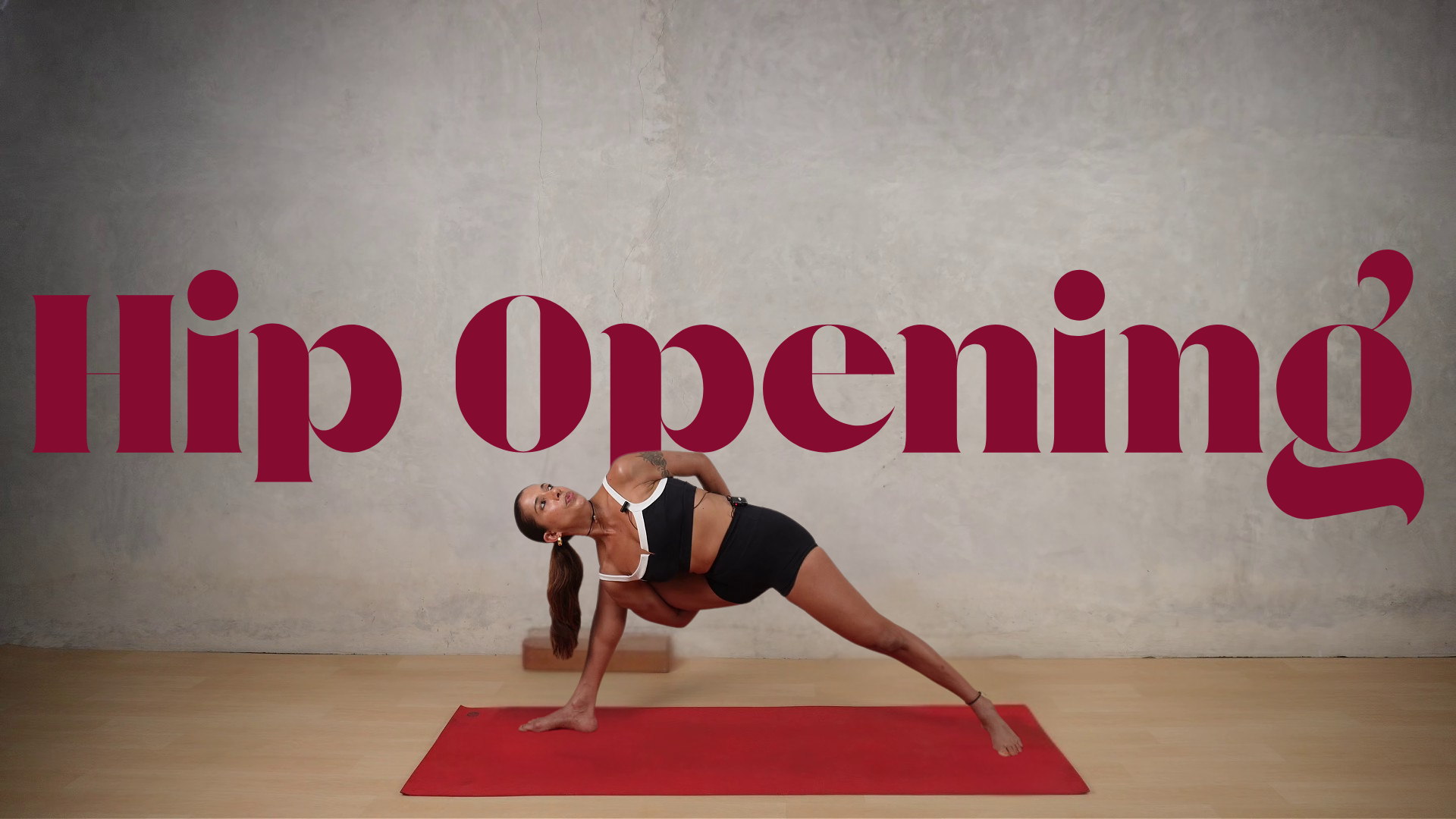
Hip Opening
Mobility and active flexibility for the hips
Hips carry a lot of expectation in yoga.
They’re often labeled as “open” or “blocked”, as if progress depended on anatomy alone. Over time, this creates pressure to push deeper, even when the body isn’t ready to support that range.
When mobility is chased without foundations, tension and frustration tend to follow.
When hips don’t respond the way you expect
You may notice patterns like:
stretching regularly, yet range doesn’t hold
feeling relaxed in a pose, but unstable when coming out
knee discomfort during lotus or rotational work
hamstrings feeling exposed or irritated
splits and pancake feeling close, but never accessible
These experiences are common when mobility is approached without enough structure.

Hip mobility is often pushed without building enough control.
The joint moves further, but the surrounding muscles don’t learn how to support the movement. Control is missing. Load shifts to the knees or hamstrings, and the body starts to protect itself.
Without strength inside the range, flexibility becomes fragile.
Range needs support
Opening the hips isn’t about relaxing more.
It’s about staying present and strong inside the movement.
When range is supported by control, the body allows it to expand.
Mobility becomes usable, not something to manage carefully.
This course was created to reframe how hip opening is built.
Instead of aiming for end positions, the work focuses on how range is earned, how it’s stabilized, and how it transfers into yoga postures.
Different movement approaches come together to support a grounded, complete way of working with the hips.
In this course you’ll work with:
mobility drills and FRC-inspired work to build usable range
passive and active flexibility, so the body can relax and support at the same time
foundations for front split, side split, and pancake
strategies for lotus and leg-behind-head without stressing the knees
strength-based support for hamstrings and hip flexors
The intention is to develop range the body feels safe inhabiting, not to force openne

This is a recorded course of approximately two hours.
You can pause, revisit, and study the material as needed.
The work integrates gradually, often over one to two months, as strength and coordination develop.
Access is lifetime, so you can return whenever your practice changes.
Who this course is for:
practice yoga and feel limited by hip mobility
are working through Ashtanga Primary Series and notice hips as a main barrier
want to move beyond the idea of “bad hip genetics”
are interested in a structured, strength-based approach to flexibility
Who this course is not for:
are dealing with an acute injury or recent surgery
want only passive stretching without active involvement
are not open to working progressively and with attention
Hip Opening
Mobility and active flexibility
99$
79$
Special launch price valid for two weeks only
One-time payment
Lifetime access
Recorded course: approx. 2 hours
Designed to be revisited over time, as strength and range develop together.
Your Questions, Answered
-
No. This course is designed to build flexibility gradually, starting from strength and control.
-
Yes. The course provides foundations that support front-split, side-split, and pancake positions.
-
Yes, when practiced with attention. A strong focus is placed on protecting the knees through proper hip support
-
No. This is a recorded course of approximately two hours, allowing you to pause, rewatch, and study details as needed.
-
If you are dealing with an acute injury or recent surgery, this course may not be appropriate at this time. This work is educational and not a substitute for medical or rehabilitative care.
-
You have lifetime access, so you can return to the material whenever it feels relevant.