
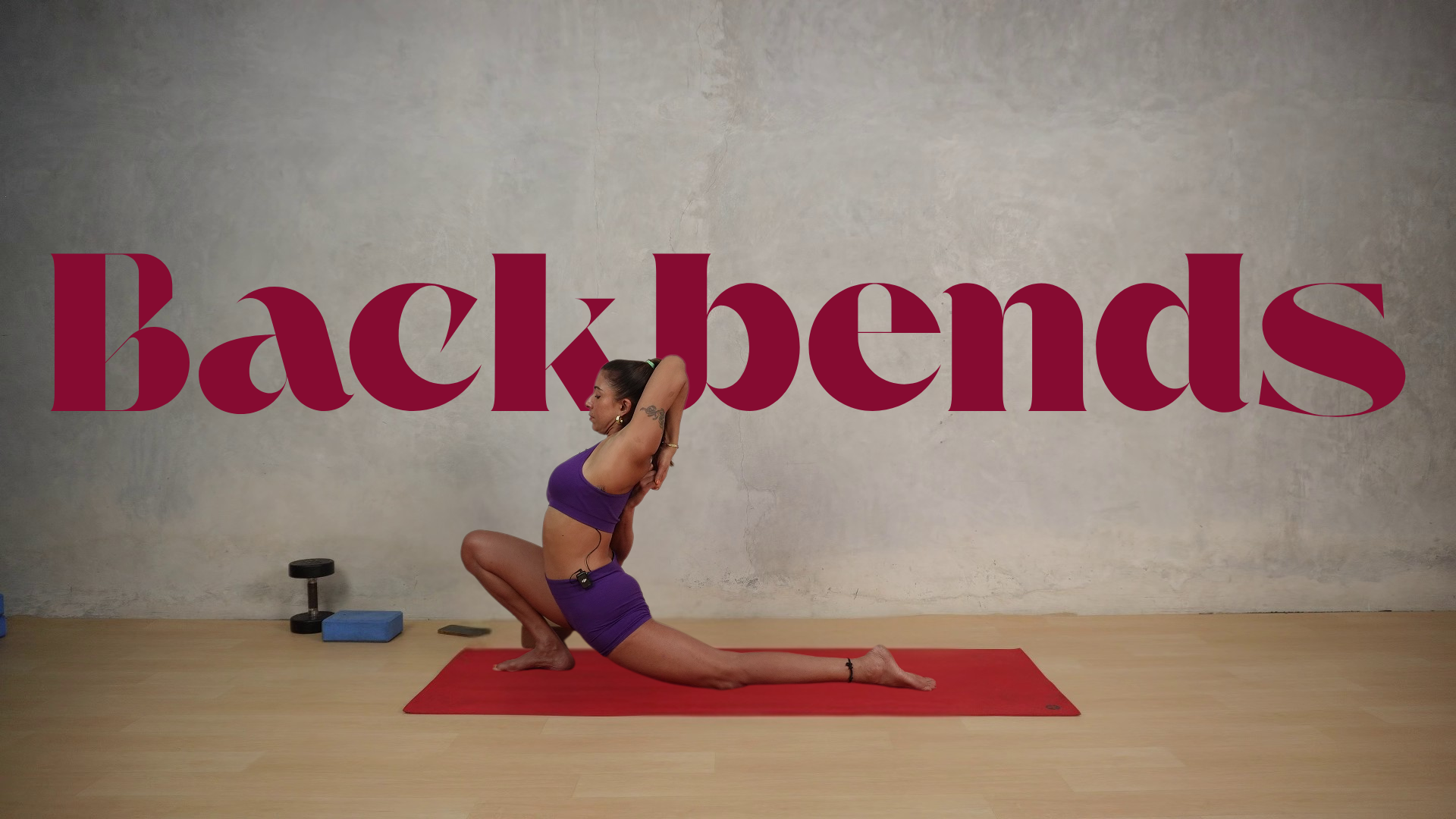
Backbends
Backbends without pain or fear
For many people, backbends come with a familiar mix of effort, tension, and hesitation.
The breath shortens. The body tightens. The lower back takes over.
This course is an invitation to approach backbends differently.
To feel supported before opening, and to let the spine move without being pushed into shape.
Backbends are often the place where practice starts to feel uncertain.
They can bring up fear, resistance, or a sense of instability, even for experienced practitioners.
Over time, what once felt expansive can begin to feel heavy or unsafe.
When backbends don’t feel safe anymore
You might recognize some of these sensations:
a heavy feeling in the lower back after backbends
compression instead of spaciousness
shoulders gripping as the spine bends
hesitation or fear before entering poses like Wheel
stiffness that feels stronger when the body is cold or tired
In these moments, the body is not resisting the pose.
It’s asking for more support and clearer distribution of work.

In many backbends, the spine ends up doing most of the work.
When support from the legs, hips, and shoulders is missing, movement concentrates in a few areas. The lower back compresses. The breath shortens. Effort replaces coordination.
At the same time, the nervous system doesn’t feel fully at ease.
Without a sense of safety, the body holds back, even when flexibility is present.
This is why backbends can feel intense, unstable, or unpredictable, regardless of experience.
Space before depth
Backbends don’t begin with going deeper.
They begin with creating space.
Space that allows the spine to extend without being compressed.
Space that lets effort spread through the whole body, instead of collapsing into one place.
When space is present, depth becomes a consequence, not a goal.
And the experience of the pose starts to change.
This course was created to offer a clear way to work with backbends, without forcing or overriding sensation.
Rather than focusing on depth or flexibility, the work looks at how the body is supported while bending, and how different parts of the body can participate more evenly.
In this course you’ll explore how to:
use legs, hips, and shoulders to support backbends
create space in the spine before moving into depth
reduce unnecessary tension in the lower back and shoulders
approach backbends with more clarity and confidence, even on days when the body feels stiff
The goal is not to achieve a specific shape, but to change how backbends feel in the body.

This is a recorded course of approximately two hours.
The format allows you to pause, revisit, and study the details at your own pace.
The work is designed to be integrated over time, often over one to two months, rather than rushed through in a single session.
Access is lifetime, so you can return to the material whenever it feels relevant.
Who this course is for:
This course is suitable if you:
are new to backbends and want to learn how to approach them without fear, pressure, or pain
have been practicing for some time, but feel stuck, compressed, or unsure about how to progress safely
are a teacher looking for clearer technical cues and a deeper understanding of how to support students in backbends
The work adapts to different levels, focusing on organization and support rather than performance.
Who this course is not for:
This course may not be appropriate if you:
are dealing with an acute injury or recent surgery
are looking only for the external shape of backbends, without interest in how they are built or sustained
are not willing to work with modifications or a gradual approach
Backbends
Backbends without pain or fear
99$
79$
Special launch price valid for two weeks only
One-time payment
Lifetime access
Recorded course: approx. 2 hours
This course is designed to be revisited over time, allowing the work to settle and integrate at your own pace.
Your Questions, Answered
-
No. This course does not rely on natural flexibility. The focus is on support, distribution of effort, and creating space in the body.
-
Yes. Many people come to this work precisely because stiffness or hesitation has become part of their experience.
-
This work benefits from time and repetition. Most people notice a shift over one to two months, as the information integrates into practice.
-
No. This is a recorded course of approximately two hours, allowing you to pause, rewatch, and study details as needed.
-
If you are dealing with an acute injury or recent surgery, this course may not be appropriate at this time. This work is educational and not a substitute for medical or rehabilitative care.
-
You have lifetime access, so you can return to the material whenever it feels relevant.